
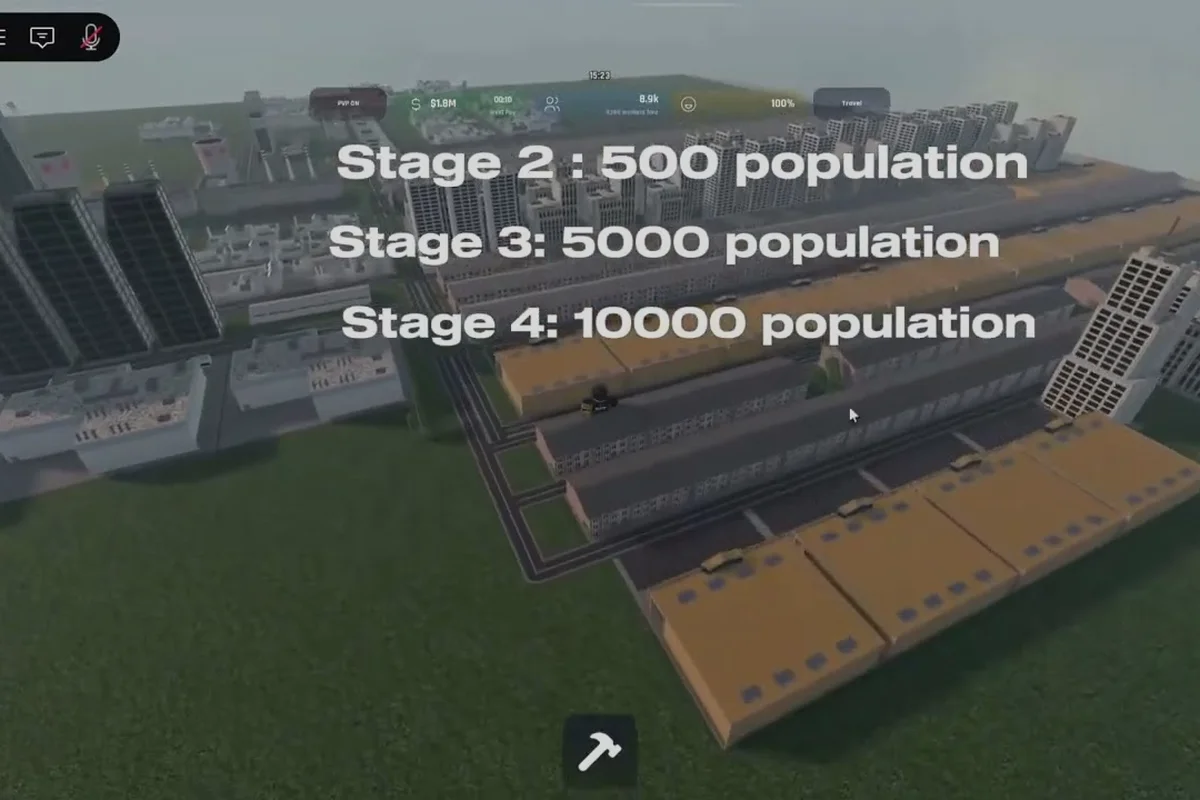
Population is the gatekeeper of every unlock in Build and Conquer, and this population growth guide shows new mayors exactly how to keep the counter climbing through the V0.1 beta. Growing your citizen count is not about spamming apartments alone — it requires a stable mix of housing capacity, happiness, food, and jobs so new settlers actually arrive and stay. Inside, you will find the feedback loop linking workers, happiness, and war budget, the community-tested Apartment Spam approach with its trade-offs, and concrete service-building placements that push you past the 250 population milestone toward city level 2.
Why Population Growth Drives Everything in Build and Conquer
Population is the single resource that gates every other system in Build and Conquer. Housing capacity unlocks the workers who staff your production lines, the tax base that funds your war budget, and the consumer demand that turns a row of shops into a genuine revenue engine. When your population stalls, income stalls, and when income stalls you cannot afford the very service buildings that keep citizens content. This population growth guide is built around that feedback loop so new mayors can escape the early-game trap where their city simply refuses to scale.
The V0.1 beta economy revolves around three tightly linked pillars: Workers who staff production and must be kept supplied as the city grows, Happiness that service and defense buildings protect, and a War Budget that military upkeep draws from — meaning defense spending must never starve the city. Understanding how these three pillars interact is the first step toward steady headcount growth, because citizens only move into new housing when the city is calm, employed, and economically stable.
According to a dedicated guide video on population growth, players can maximize their citizen expansion by ensuring steady resource flow and strategically placing residential zones near completed infrastructure projects.
According to the official Build and Conquer community guides, the most reliable method for sustaining population growth is to construct a balanced mix of housing structures alongside steady food production, since new settlers only arrive when both shelter and nourishment are available.
According to community-driven video guides on population growth, the most efficient way to expand your population in Build and Conquer is to maintain a steady surplus of housing, keep morale high through consistent food delivery, and avoid overcrowding penalties by spacing residential zones across multiple resource nodes, as demonstrated in the Build and Conquer population growth guide.
Housing, Income, and the Population Feedback Loop
Population growth in Build and Conquer is not a single knob you can crank. It emerges from a chain of small, repeatable decisions about housing capacity, citizen happiness, and disposable income. If any link in that chain is weak, your population curve flattens and your city plateaus well before hitting the 250 population unlock that gates higher city levels. The fastest known method new players use to raise headcount is what the community calls Apartment Spam — stacking apartment blocks next to each other so the city's effective housing ceiling rises in a single build cycle. This works because apartments are the cheapest source of raw housing capacity, but it also creates a problem: hundreds of new citizens arrive before you have the services to support them.
The V0.1 beta shops, supermarkets, and malls are the main early revenue engines, and each of them is sensitive to both population density and the Road Network that connects them. A supermarket plopped down at the edge of your city with no road connection will generate almost no revenue, while the same supermarket placed along a high-traffic corridor between an apartment block and a production zone can return several times that income. Once you have a few supermarkets humming, you can afford the service buildings that keep your citizens from becoming sour, which in turn lets you push apartment construction even harder.
| Income Source | Best Placement | Strength | Weakness |
|---|---|---|---|
| Shops | Near residential clusters | Fast construction, low upkeep | Modest revenue ceiling |
| Supermarkets | Along commuter roads | Strong mid-game income engine | Needs road connectivity |
| Malls | City center or transit hubs | Highest per-tile revenue | Expensive to build and maintain |
| Tax Income | Stable, happy population | Scales passively with population | Falls when happiness drops |
Pairing this with the broader income strategy guide gives you a full picture of how the city funds its own expansion. Supermarkets in particular are the unsung hero of the early game, because they produce reliable coin without requiring the war budget that defense buildings consume.
How to Keep Citizens Happy in the V0.1 Beta
Happiness is the multiplier on every other system. A citizen who is fed, employed, entertained, and protected will pay taxes, consume goods, and tolerate the next apartment block going up next door. A citizen who is unhappy will move out, abandon their job, and erode the very tax base you were counting on. Service and defense buildings keep citizens from turning sour, and the city's overall happiness rating is a single number you can watch rise or fall in real time. When it falls, the population graph follows within a few in-game days.
The four reliable sources of a happiness boost in the current V0.1 beta build are service buildings, defense structures, stable employment, and reliable supplies, and each one feeds into the same underlying population growth loop by preventing citizens from leaving. In practical terms, the happiness rating in the top-left HUD is the variable that gates your net population change, so when a new district goes online you can usually expect a 5–15 point swing in either direction within the first in-game week depending on whether the four sources are covered.
-
Service buildings such as clinics, parks, and entertainment venues raise happiness across a wide radius and stack multiplicatively.
-
Defense buildings lower the threat of raids, which in turn keeps citizens from fleeing. The community reports that a single defensive structure can stabilize an entire district.
-
Stable employment means your workers actually have jobs to walk to. An unemployed citizen is almost always an unhappy citizen.
-
Reliable supplies keep shops and supermarkets stocked, which means citizens can buy what they need and businesses do not close.
If you want a deeper breakdown of how to defend your city while keeping citizens content, the alliance and defense walkthrough explains how military commitments interact with citizen morale. The short version is that every defensive coin you spend buys a slice of happiness, and every slice of happiness buys you a few more citizens willing to stay.
Service Buildings vs. Defense Buildings
| Building Type | Happiness Effect | Best Use | Common Mistake |
|---|---|---|---|
| Clinic | +Medium radius, stacks with other services | Place near dense housing | Building too early without income |
| Park | +Small radius, very cheap | Fill gaps between apartment blocks | Ignoring coverage overlaps |
| Entertainment | +Large radius, expensive | One per district | Skipping because of cost |
| Watchtower | Prevents raid-driven happiness loss | Border tiles near threat routes | Forgetting upkeep cost |
| Wall Segment | Blocks raids entirely | Choke points | Sealing off your own trade roads |
The biggest mistake new players make is treating service buildings as a luxury rather than a foundation. In reality, they are the precondition for apartment spam to actually work. You can build fifty apartments in a row, but if you have not laid down a single clinic, the new citizens will arrive stressed and leave within the cycle.
The Apartment Spam Strategy Explained
Apartment spam is the fastest known way to raise headcount in the V0.1 beta, and the strategy is straightforward in principle: build apartment blocks as fast as you can afford them, in tight clusters, alongside the road network that connects them to jobs and shops. In practice, the strategy fails when players forget that each new apartment also raises the demand for services, road capacity, and consumer goods. The trick is to interleave apartment construction with service building construction so the city's happiness rating never dips.
A common rhythm reported by players on the build and conquer population growth guide forums looks like this 5-step loop: drop two or three apartment blocks in a fresh district, immediately connect the new road tile to a production zone, then place a clinic or park within walking range before the apartment finishes constructing, and finally slot a supermarket at the road junction so the new citizens spend their wages at a building you own.
-
Build 2-3 apartment blocks in a new district.
-
Immediately connect the district with a road to a production zone.
-
Drop a clinic or park within range of the new apartments.
-
Place a supermarket at the road junction that the new citizens will walk through on their commute.
-
Watch the population counter tick up; repeat the cycle.
This rhythm is what makes the strategy sustainable. If you skip step 3, your happiness will drop and the new citizens will leave before they ever pay a single coin in tax. If you skip step 4, you miss the chance to capture the consumer spending from your new arrivals. If you skip step 2, your workers have no jobs and unemployment eats into your happiness rating.
| Build Step | Approximate Cost | Effect on Population | Risk if Skipped |
|---|---|---|---|
| 2-3 Apartments | Low | +40-60 citizens | None if income is stable |
| Road Connection | Very low | Enables worker flow | Unemployment spike |
| Clinic or Park | Medium | +Happiness boost | Citizens leave quickly |
| Supermarket | Medium | +Recurring income | Missed consumer revenue |
When you are ready to push toward the higher city tiers, the city upgrade requirements guide covers the exact population thresholds you will need to clear. Most of those thresholds are designed so that you must use apartment spam plus sustained happiness to reach them, rather than simply building for raw headcount.
Milestones, Pitfalls, and the Road to Stable Growth
The V0.1 beta gates several major city upgrades behind population thresholds, which means steady growth is more valuable than explosive growth. A city that jumps from 80 citizens to 200 in a single afternoon will almost always crash back down within a few in-game days because the supporting infrastructure cannot keep up. A city that grows from 80 to 200 over the course of a week, with services and shops added at every step, will hold that population and keep producing revenue.
Three pitfalls derail most new mayors in the V0.1 beta, and each one is a direct consequence of skipping the steady-growth rhythm that keeps apartment blocks earning instead of emptying: spending the war chest on defenses before supermarkets go online, laying residential zones without first connecting them to a road that actually reaches a commercial tile, and watching the happiness meter slide for several in-game days before reacting. The community has narrowed the root cause down to a single phrase — apartment spam — because every reported collapse traces back to housing added faster than services, jobs, and consumer spending can absorb it.
-
Ignoring the war budget. Military upkeep means defense spending must never starve the city. If you over-build walls and watchtowers before your supermarkets are online, your income collapses and your happiness follows.
-
Forgetting road connectivity. A supermarket that no one can reach is a building that earns nothing. Roads are cheap, and the revenue multiplier from connecting your commercial buildings to residential zones is enormous.
-
Letting happiness drift. Once the happiness rating starts to slide, it is very hard to reverse, because unhappy citizens leave, which lowers tax income, which means you can no longer afford the services that would have made them happy.
A simple weekly checklist that experienced players use to keep their cities on track looks like this: each in-game day opens with a five-question audit on income, happiness, employment, defense, and growth, and the audit only counts as passing when every box returns a clean answer — otherwise the mayor pauses apartment construction and routes the next cash injection toward the failing metric, which is the exact rhythm that prevents the apartment-spam collapse that wipes out roughly half of new V0.1 beta cities before they reach the 200-citizen tier.
-
Income check: Are my supermarkets and shops earning enough to cover service upkeep plus a small reserve?
-
Happiness check: Is the city-wide happiness rating at or above neutral?
-
Employment check: Are my workers walking to jobs, or do I have idle citizens?
-
Defense check: Are my border tiles protected against raids that would tank happiness?
-
Growth check: Is my population counter still climbing, or has it plateaued?
If any of those five answers is "no," the priority is to fix it before doing any more apartment construction. Apartment spam without a stable foundation is the single most common reason a city stalls in the early V0.1 beta economy, and the community has been very consistent in reporting that patience outscales aggression almost every time.
For a wider view of how population interacts with the rest of the game's economic systems, the economy fundamentals guide covers tax collection, budget management, and the relationship between cash flow and city tiers. Pairing that overview with the apartment spam rhythm described above gives you a complete loop: build housing, raise happiness, capture consumer spending, and reinvest in services that let you build more housing.
Frequently Asked Questions
What is the fastest way to raise population in the V0.1 beta?
Apartment spam is the fastest known method — stack apartment blocks in tight clusters and connect them to a road network so the spawn radius overlaps nearby shops. The strategy only works when paired with a clinic or park inside that same district, because each new citizen arriving without local services will start losing happiness within seconds and leave before paying any residential tax.
How do I keep citizens happy without going bankrupt?
A clinic covers roughly twice the radius of a small entertainment venue for about a third of the ongoing upkeep cost, and a single park can service an entire apartment cluster if placed centrally, so prioritize those two first. Entertainment venues like theaters or stadiums and large defense structures such as bunkers only become viable once your supermarket tax income consistently outpaces the combined drain of military upkeep plus service maintenance — otherwise the negative happiness from unpaid services will trigger emigration faster than new citizens can spawn.
Do supermarkets really matter for population growth?
Yes. Supermarkets sit between your apartment blocks and your wallet, and they convert residential density into recurring coin. That income is what pays for the service buildings that protect your happiness rating, which in turn keeps your new citizens from leaving.
Can I lose population even after building more apartments?
Yes — and the failure is usually invisible until your residential tax income crashes. In the V0.1 beta, the apartment spawn radius extends roughly 1.5x the road tile range, so a four-block apartment cluster with zero service coverage will fill up, then hemorrhage citizens within 30 in-game seconds as happiness drops below the emigration threshold. Drop a single clinic inside the overlap zone and the same cluster stabilizes, which is why the apartment-plus-clinic pairing is the baseline unit of every working population build rather than an optional add-on.
How does the war budget affect population?
Military upkeep is a fixed drain on your income, and if defense spending crowds out service upkeep, happiness will fall and citizens will leave. Treat the war budget as a fixed cost that your commercial buildings must always cover, and build your population strategy on top of that stable base.