
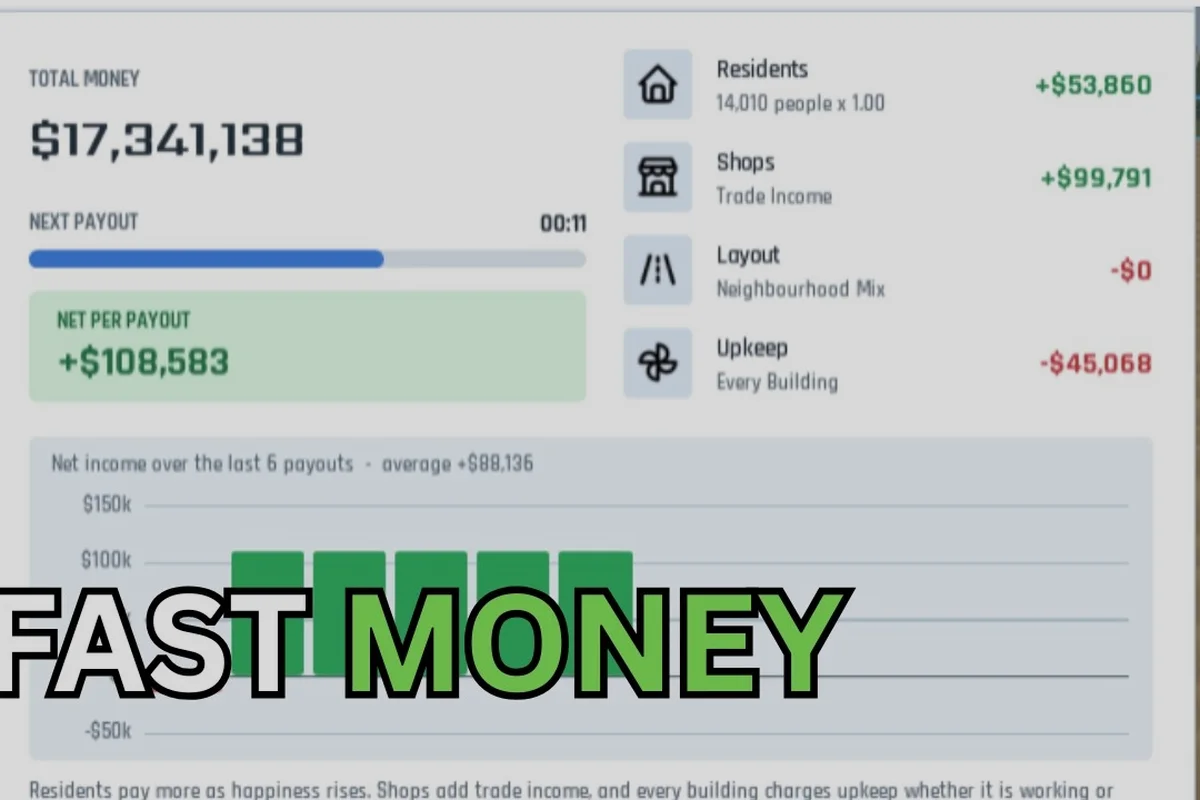
Growing your workforce in Build and Conquer is less about clicking a single button and more about managing a fragile chain of income, housing, and happiness. The V0.1 beta economy punishes players who expand their population too quickly without first stabilizing their commercial base, which is why a clear wage guide and spending priority plan matters from the very first hour. This breakdown covers the exact levers that determine how to get more workers without collapsing your city into debt.
Understanding the Worker Pipeline
Workers in Build and Conquer do not appear out of thin air. They staff production buildings, keep supply lines moving, and directly influence how fast your city can respond to both economic and military pressure. The core loop that determines how to get more workers starts with apartment spam, which community testers consistently identify as the fastest known way to raise headcount in the V0.1 beta. However, adding housing without matching income creates a cascade of problems that can stall your entire run.
| Building type | Revenue role | Worker impact | Community-reported income | Placement timing |
|---|---|---|---|---|
| Shop | Early commercial anchor | Funds 1–2 apartment blocks | 40–60 credits per cycle (with supermarket) | Before second apartment block |
| Supermarket | Primary early revenue engine | Unlocks 2 additional housing units | 40–60 credits per cycle | Before second apartment block |
| Mall | Mid-tier commercial scaling | Supports larger apartment spam batches | Varies with layout (community-reported) | After shops/supermarkets confirmed profitable |
| Apartment | Housing supply | Raises headcount fastest (apartment spam) | No direct income; drains treasury if built first | After commercial anchor, in batches of 2–3 |
The relationship between population and production is not linear. Each new worker requires a job slot, and each job slot requires a building that generates enough revenue to justify its upkeep. According to community footage and player reports from October 2026, the most reliable early revenue engines are shops, supermarkets, and malls. These commercial buildings feed your treasury, which in turn funds the apartments that house your growing workforce. If you build apartments first and shops later, you will watch your balance drain while workers stand idle.
A practical expansion sequence looks like this: start by checking your current daily income against your military upkeep and service upkeep, because the beta's economy punishes any building order that outpaces your revenue stream. For example, community testers in October 2026 found that placing a supermarket before your second apartment block generates roughly 40–60 credits per cycle, enough to fund two additional housing units without triggering the idle-worker penalty. Once that commercial anchor is confirmed profitable, layer apartment spam in small batches of two to three blocks, then pause to verify that happiness has not dipped below the threshold where production buildings lose efficiency. This staged approach keeps your job slots aligned with actual treasury flow, avoiding the common trap where players expand housing first and then scramble to retrofit shops or malls into a city already bleeding upkeep.
-
Place one new commercial building and confirm it is producing income.
-
Add two to three apartment blocks to absorb the new labor pool.
-
Check your happiness rating before adding another production facility.
-
Repeat the cycle only when your daily income exceeds your military and service upkeep.
This rhythm prevents the most common failure state in the beta: a city with hundreds of residents but no functional economy to support them. The official Roblox game page for Build and Conquer confirms the strategy genre framing, but the real depth comes from how players balance these systems under pressure.
Wage Budget and Spending Priorities
A wage guide for Build and Conquer is not about setting a single number. It is about deciding which systems receive funding first when your treasury is limited. The V0.1 beta includes a War Budget mechanic that ties military upkeep directly to your civilian economy. Defense spending must never starve the city, but over-investing in military infrastructure before you have a stable commercial base will slow your worker growth to a crawl.
The spending priority framework that experienced players use breaks down into four tiers, each tied to a specific phase of your city's growth cycle. The logic is simple: commercial income buildings generate the tax revenue that funds every other system, so they must come first — without shops and markets, you have no treasury to pay for apartments or services. Once income is flowing, housing converts that revenue into actual worker headcount, which is the entire point of the build and conquer how to get more workers loop. The third tier, service and happiness buildings, acts as a productivity multiplier: a satisfied worker produces more output per shift than a sour one, meaning the same population yields higher tax income. Finally, military and defense sits last not because it is optional, but because building walls and barracks too early drains your treasury into structures that generate zero civilian jobs — a common mistake that leaves players with a well-defended city and nobody living in it.
| Priority Tier | Spending Focus | Impact on Workers | Risk if Ignored |
|---|---|---|---|
| 1 | Commercial income buildings | Creates job slots and funds expansion | No revenue to support housing |
| 2 | Apartments and housing | Directly increases worker headcount | Population stalls |
| 3 | Service and happiness buildings | Keeps citizens productive | Workers become sour and inefficient |
| 4 | Military and defense | Protects the city from raids | City vulnerable to attacks |
This table reflects community-reported data from the V0.1 beta, and exact income figures vary with layout and building placement. The key insight is that spending priorities must shift as your city grows. Early on, almost everything goes into shops and apartments. Later, service buildings and defense become non-negotiable because a single raid can wipe out the workforce you spent hours building.
Early Game Economy: The First 30 Minutes
The early game economy in Build and Conquer rewards aggressive but controlled commercial expansion. Your first goal is to reach a positive daily income as quickly as possible, because every subsequent worker depends on that surplus. Players who delay their first shop or supermarket often find themselves unable to afford even a single apartment upgrade, which stalls the entire worker pipeline.
A common early sequence reported by players looks like this: open with a single shop placed directly against your starting residential zone, then hold off on any further commercial investment until the shop’s daily income stabilizes above its maintenance cost. This waiting period is critical because the beta’s revenue model calculates shop output from adjacent population density and overall city activity — a shop built too early in an empty corner generates almost nothing, while one wedged between two apartment blocks can double its baseline income within the first ten minutes. Players who rush a second shop before their first apartment upgrade typically report a 15–20 minute delay in reaching positive daily income, simply because the extra maintenance eats the surplus that would otherwise fund the next worker.
-
Build one shop immediately and place it near your starting residential zone.
-
Save enough for a supermarket rather than buying multiple small shops.
-
Add apartments only after both commercial buildings show steady income.
-
Delay military buildings until your first three apartment blocks are full.
The reason this works is that commercial buildings in the beta generate revenue based on proximity to population and overall city activity. A shop surrounded by apartments outperforms a shop placed in an empty corner. This spatial element means your early game economy is as much about layout as it is about building selection.
Late Game Economy: Transitioning to Scale
The late game economy in Build and Conquer shifts from survival to optimization. Once you have a stable workforce of several hundred workers, the challenge becomes maintaining happiness and defense without draining your commercial surplus. Malls become the dominant revenue source at this stage because they serve larger populations more efficiently than individual shops.
The transition point usually arrives when your daily income comfortably exceeds your combined military and service upkeep by at least 30 percent. At that point, you can afford to experiment with more aggressive expansion strategies. Some players push apartment spam even harder, while others invest in defensive infrastructure to protect their existing workforce from raids. Both approaches work, but they require different spending priorities.
How to Get More Workers Without Crashing Your Economy
The most direct answer to how to get more workers in Build and Conquer is to build more apartments. But the reason so many players struggle is that they treat housing as an isolated action rather than part of a larger economic loop. Every apartment you place increases your population, which increases demand for services, which increases upkeep, which reduces the surplus you need for the next apartment. Breaking this cycle requires a deliberate approach to money making tips that prioritize sustainable growth over rapid expansion.
One effective strategy is to pair every new housing block with a service building. This keeps happiness stable and prevents the productivity loss that comes from sour citizens. Community reports indicate that unhappy workers produce less and may even abandon their jobs, which effectively reduces your workforce without any population loss. The fix is not more apartments but better service coverage.
Another overlooked lever is fuel production. Workers need fuel to operate production buildings, and a shortage can idle your entire industrial sector. Players who neglect fuel infrastructure often wonder why their workforce is growing but their output is not. The answer is usually a supply bottleneck, not a labor shortage. For a deeper look at this system, the fuel production guide breaks down the exact buildings and ratios you need to keep your production lines running.
Avoiding the Military Trap
The War Budget in Build and Conquer is a double-edged sword. Military buildings protect your city, but their upkeep scales with the size of your army. If you build too many defensive structures too early, you will spend every coin on upkeep and have nothing left for apartments or commercial expansion. The result is a city that is safe but stagnant.
The solution is to treat military spending as a response to actual threats, not a default investment. In the early game, a minimal defensive force is usually enough to deter raids. In the late game, when your city is large enough to attract serious attacks, you can afford to expand your military because your commercial base is already generating significant income. This timing distinction is one of the most important spending priorities in the entire game.
Money Making Tips That Actually Scale
Most money making tips for Build and Conquer focus on building more commercial structures, but the real secret is placement and density. A mall surrounded by high-density apartments generates far more income than the same mall placed in a low-density area. This is because revenue in the beta appears to scale with nearby population, which means your commercial and residential zones should grow together rather than in separate districts.
The following table compares the three main revenue buildings based on community-reported performance, but the raw income numbers only tell half the story — worker capacity is the hidden multiplier. A Shop generates modest gold but unlocks only a handful of job slots, which caps your early population and therefore your tax base. The Supermarket roughly doubles both income and worker slots, making it the backbone of mid-game expansion when you need to fund apartment blocks without overbuilding commercial zones. The Mall, by contrast, produces the highest raw income but only pays off when placed adjacent to high-density housing; a Mall surrounded by low-density zones underperforms a well-placed Supermarket, so treat the building tier as a density requirement rather than a strict upgrade path.
| Building Type | Best Use Case | Income Potential | Worker Impact |
|---|---|---|---|
| Shop | Early game starter income | Low but reliable | Creates initial job slots |
| Supermarket | Mid game scaling | Medium | Supports larger populations |
| Mall | Late game optimization | High | Requires dense housing nearby |
This data comes from creator testing and varies with layout, so treat it as a starting point rather than a fixed formula. The pattern is clear: as your city grows, you should shift from shops to supermarkets and eventually to malls. Each transition unlocks more income per building, which funds the next wave of apartment construction.
The Happiness Multiplier
Happiness is the hidden multiplier in the Build and Conquer economy. Service and defense buildings keep citizens from turning sour, and sour citizens are less productive. This means your effective workforce is always lower than your raw population if happiness is neglected. Players who focus exclusively on apartments and commercial buildings often hit a wall where adding more workers does not increase output, and the cause is almost always low happiness.
The fix is straightforward: build service buildings before you expand housing. A single well-placed service building can support multiple apartment blocks, so the cost is relatively low compared to the productivity gains. This is one of the most underrated spending priorities in the game, and it becomes increasingly important as your city approaches the late game.
Frequently Asked Questions
How do I get more workers fast in Build and Conquer?
The fastest method is apartment spam, which means building multiple apartment blocks in quick succession. However, you must pair this with commercial income buildings like shops and supermarkets, or your economy will collapse. Community testers confirm this is the quickest headcount boost in the V0.1 beta.
What is the best wage budget setup for beginners?
Focus your first 30 minutes on commercial buildings, then add apartments. Keep military spending minimal until your income surplus exceeds upkeep by at least 30 percent. This wage guide prioritizes sustainable growth over rapid expansion, which prevents the debt spiral that stalls most new players.
Why are my workers not producing anything?
The most common cause is a fuel shortage, not a labor shortage. Workers need fuel to operate production buildings, and an idle production line looks identical to a labor problem. Check your fuel infrastructure before building more apartments, because adding workers to a starved system will not increase output.
When should I transition from shops to malls?
Transition to malls when your city reaches high population density and your daily income comfortably exceeds upkeep. Malls generate more income per building but require dense housing nearby to reach their full potential. This late game economy shift unlocks the revenue needed for large-scale apartment expansion.
Does military spending reduce my worker count?
Military spending does not directly reduce workers, but it consumes budget that could fund housing and commercial expansion. The War Budget mechanic means every defensive building increases upkeep, which reduces the surplus available for apartments. Balance military investment against civilian growth to avoid stagnation.