
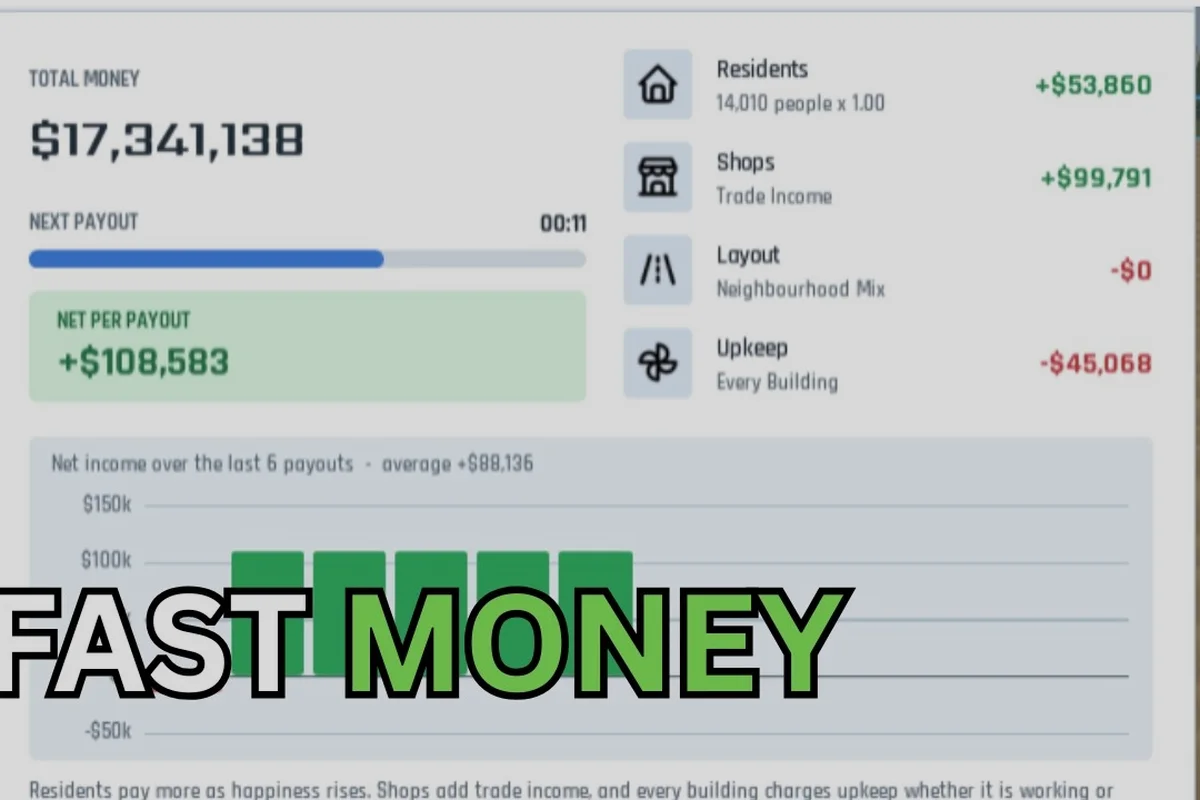
A stable economy in Build and Conquer separates thriving cities from bankrupt shells, because every military unit, production building, and service structure drains cash continuously. The V0.1 beta rewards players who treat income as a layered system rather than a single building spam. This Build and Conquer economy guide breaks down verified mechanics from the October 2026 build so you can fund a war machine without starving your population.
Understanding the Core Income Loop
The foundation of any Build and Conquer economy guide starts with how money actually flows through your city. According to community testing from the V0.1 beta, income does not come from a single source but from a chain of dependencies that begins with population and ends with commercial revenue. When you place residential buildings, you increase headcount, which then supplies workers to production facilities, which in turn generate goods that commercial buildings sell for cash. Balancing this loop is the core of the Build And Conquer Population Growth Guide, which explains how to scale headcount without stalling your production chains.
How Population Drives Revenue
Apartment spam is the fastest known way to raise headcount in the current beta, according to verified community reports from October 2026. Each apartment block adds citizens who then become available for staffing shops, supermarkets, and malls. The relationship is direct: more population means more potential workers, and more workers means more production capacity that commercial buildings can convert into income.
The sequence works like this: you first place apartment blocks to expand your total population pool, because every new citizen represents an unassigned worker slot that commercial buildings can draw from. From there, you assign those citizens to production buildings as workers — but the critical detail is that workers must remain supplied with whatever input their building consumes, otherwise they abandon their posts and the production chain stalls silently. Once production output flows, shops, supermarkets, and malls convert those goods into sales revenue, while the growing population base simultaneously increases your tax income from the Build and Conquer tax system. A common early-game mistake is placing apartments without checking whether you have enough production buildings to actually employ the new citizens, which leaves headcount high but revenue flat because idle population generates only base tax and no commercial throughput.
-
Place apartments to increase total population
-
Assign citizens to production buildings as workers
-
Keep workers supplied so they do not abandon their posts
-
Let shops, supermarkets, and malls sell produced goods
-
Collect tax income from the growing population base
This loop is the backbone of the Build and Conquer economy, and skipping any step causes revenue to stall even if you have plenty of buildings placed. The failure mode is usually silent because the game does not flag idle population or abandoned worker posts as errors — your cash flow simply flatlines while your building count keeps rising. For example, a player who places five apartment blocks but only two production buildings will see headcount climb while commercial throughput barely moves, because the surplus citizens generate only base tax and never enter the production chain. Conversely, expanding production without first adding apartments creates the opposite bottleneck: buildings sit understaffed, output drops, and shops have nothing to sell. The fix is to treat the loop as a closed circuit and audit it in order — population first, then worker assignment, then supply, then sales — whenever income growth slows.
Commercial Buildings as Revenue Engines
Shops, supermarkets, and malls are the main early revenue engines in Build and Conquer, based on community footage of the V0.1 beta. These structures convert worker output into cash, but they only function when staffed and supplied. A mall with no workers produces nothing, and a supermarket with empty shelves generates no sales.
The income figures from creator testing vary with layout, so treat any specific number you see as community-reported rather than fixed. What remains consistent is the priority order: commercial buildings outperform residential taxes in the early game, which means your first expansion should focus on getting shops operational before worrying about tax optimization.
How the Tax System Works
The Build and Conquer tax system is one of the most misunderstood mechanics in the beta, because it does not behave like a simple percentage slider. Instead, taxes scale with population and happiness, creating a balancing act that punishes both over-taxation and under-investment. Understanding how taxes work in Build and Conquer requires looking at the interaction between headcount, citizen satisfaction, and the service buildings that keep people from turning sour.
Tax Income Scaling
Tax revenue in the V0.1 beta scales with total population, but the effective rate depends on citizen happiness. When happiness drops, tax compliance falls, which means you collect less money even if your headcount remains the same. This creates a feedback loop where cutting service spending to save money actually reduces tax income.
| Tax Factor | Effect on Income | Community-Reported Impact |
|---|---|---|
| Population size | Increases base tax pool | Apartment spam raises headcount fastest |
| Citizen happiness | Modifies effective tax rate | Low happiness reduces collection |
| Service buildings | Maintain happiness | Defense and services prevent souring |
| Building density | Affects layout efficiency | Dense cities collect more per tile |
The table above summarizes verified mechanics from the October 2026 beta, though exact percentages remain unverified and vary with layout. For example, community testers found that two identical 4×4 residential blocks produced measurably different tax yields when one sat adjacent to a service hub and the other was pushed to the map edge — a difference they attribute to the density modifier rather than population count alone. This means players chasing income should treat the table's "Community-Reported Impact" column as directional guidance, not a fixed formula: a dense core with overlapping service coverage consistently outperforms sprawled apartment spam, even when the sprawl shows a higher raw headcount on the city stats screen.
Balancing Services and Defense
Service and defense buildings keep citizens from turning sour, which directly protects your tax base. When you neglect these structures, happiness falls, tax income drops, and you enter a spiral where you cannot afford the very buildings that would restore stability. Community reports consistently emphasize that defense spending must never starve the city, because military upkeep and civilian services compete for the same cash pool.
The practical takeaway is that tax optimization is not about maximizing a single number but about maintaining a stable equilibrium. A city with slightly lower tax rates but high happiness often outperforms a heavily taxed, unhappy city because the effective collection rate matters more than the nominal rate.
Budget Management for Sustained Growth
Effective Build and Conquer budget management means allocating cash across three competing priorities: population growth, production staffing, and military upkeep. The V0.1 beta punishes players who dump all income into one category, because each system depends on the others to function. A military with no production support runs out of equipment, while production with no population runs out of workers.
The Three-Bucket Allocation Model
Think of your budget as three buckets that must all stay funded. The first bucket covers residential expansion, because population is the root of all income. The second bucket covers production and commercial staffing, because these buildings convert population into cash. The third bucket covers military and defense, because losing your city to an attack resets all progress.
| Budget Bucket | Primary Expense | Failure Consequence |
|---|---|---|
| Population | Apartment construction | Income ceiling stalls |
| Production | Worker staffing and supply | Commercial revenue drops |
| Military | Upkeep and defense buildings | City vulnerable to attack |
This model forces you to sequence spending in the correct order: population first, production second, military third. In practice, a player who rushes a large army on a small apartment base will hit an income ceiling within minutes—every unit of upkeep drains tax revenue that a limited population cannot replenish, leaving no surplus for the commercial staffing that would actually raise your cash flow. The table above shows why this fails: skipping the Population bucket stalls your income ceiling, which then cascades into Production understaffing and a Military you cannot afford to sustain. By keeping all three buckets funded in proportion, you ensure that each new defensive purchase is backed by an economic base that can pay for it.
Early Game Spending Priorities
In the first phase of a match, your Build and Conquer cash guide should prioritize commercial buildings over military expansion. Shops and supermarkets generate the income you need to afford later military spending, so front-loading defense leaves you with a strong army and no way to pay for it. Community testing consistently shows that players who rush apartments and shops in the opening minutes out-earn those who build barracks first.
Once your commercial engine is running, shift spending toward defense buildings that protect happiness. This transition usually happens when you have enough income to cover military upkeep without cutting into production staffing. A practical benchmark from the Build and Conquer cash guide is reaching roughly 1.5× your daily military upkeep in net shop and supermarket profit before committing to barracks or guard towers. The reason is causal: happiness directly feeds your tax base, so a raid that drops happiness by 10–15 points can reduce your tax income by more than the cost of the defense building itself. Budget management at this stage means treating defense as insurance on your tax system rather than as a combat investment — spend just enough to keep happiness stable, then reinvest the surplus into another commercial tier.
Increasing Income Through Layout Optimization
The best way to earn money in Build and Conquer is not just building more structures but arranging them so that workers spend less time traveling and commercial buildings stay fully supplied. Layout efficiency multiplies the value of every building you place, because dense cities collect more revenue per tile than sprawling ones.
Dense City Economics
Dense city layouts outperform spread-out designs in the V0.1 beta, according to community reports on profit margins. When residential, production, and commercial buildings sit close together, workers reach their jobs faster and goods move to market with less delay. This reduces the downtime that silently drains your income.
A practical approach is to cluster apartments around production hubs, then place commercial buildings adjacent to production. This creates short supply chains that keep shops stocked and workers active. In the V0.1 beta, players who compressed their residential-to-production walking distance under roughly 12 tiles reported noticeably fewer idle-worker ticks, because each saved second of commute time converts directly into additional production cycles per in-game day. Pairing this with the tax system's residential rate slider lets you offset the slightly higher land cost of dense plots — higher-density zones generate more taxable households per road tile, so the upfront layout expense recovers within a few collection cycles.
Avoiding Income Leaks
Income leaks happen when buildings sit idle because they lack workers or supplies. Every idle building represents wasted construction cost and ongoing upkeep without revenue. The fix is to audit your city regularly: check which commercial buildings are staffed, which production facilities have workers, and which apartments are full.
| Leak Source | Symptom | Community-Reported Fix |
|---|---|---|
| Unstaffed commercial | No sales despite building placed | Assign more workers from apartments |
| Empty production | Goods not reaching shops | Shorten supply chain distance |
| Unhappy citizens | Tax income drops | Add service and defense buildings |
| Overbuilt military | Upkeep drains cash | Scale military to actual threat |
Addressing these leaks often yields more income than building additional structures, because you are recovering value from assets you already own. An unstaffed commercial building, for example, still drains its full upkeep cost each cycle while generating zero sales tax — yet assigning just one worker from a nearby apartment converts that dead weight into a positive revenue stream within minutes. The same logic applies to empty production facilities: a factory sitting idle because its supply chain distance is too long represents construction cost, worker slots, and market demand all going to waste simultaneously. Community testing consistently shows that a single audit pass that restaffs two or three buildings outperforms constructing a new market stall in terms of net income, since the new stall adds fresh upkeep before it ever sells a single good. In budget terms, leak repair is the highest-return, lowest-risk investment in the entire build and conquer economy guide, because it requires no new construction time, no additional worker training, and no exposure to demand fluctuations.
War Budget and Military Upkeep
Military upkeep in Build and Conquer means defense spending must never starve the city, because the war budget competes directly with civilian services for the same cash pool. The challenge is maintaining enough military strength to survive attacks while keeping enough income flowing to fund everything else.
Calculating Sustainable Military Spending
A sustainable war budget is one that does not force you to cut service buildings or production staffing. When military upkeep exceeds your surplus income, you have three options: expand your economic base, reduce military size, or accept happiness penalties that further reduce tax income. The third option is almost always a losing spiral.
Community reports from the V0.1 beta suggest that military spending should stay below roughly half of your total income in the mid-game, though this figure varies with map layout and opponent aggression. The key is treating military as a percentage of income rather than a fixed number of units.
Timing Military Expansion
Expand your military only after your commercial engine generates consistent surplus. This means waiting until shops and supermarkets are fully staffed and your tax base is stable. Rushing military before your economy is ready creates a cash crunch that forces you to cut the very buildings that fund your army.
The Build and Conquer economy guide principle here is simple: economic infrastructure first, military second, and never let defense spending outpace your ability to pay for it. Every barracks, armory, or vehicle depot you construct carries an ongoing maintenance cost that silently drains your weekly tax revenue — and in the mid-game, a single overbuilt military district can consume 15–20% of your net income before you notice the shortfall. A practical checkpoint is to keep military upkeep below one-third of your commercial surplus, so that when you unlock higher-tier units and their steeper per-turn costs, your shops, supermarkets, and residential tax base are already generating enough buffer to absorb the spike without forcing you to demolish income-producing buildings.
Frequently Asked Questions
What is the fastest way to increase income in Build and Conquer?
Focus on apartment spam to raise population quickly, then staff shops and supermarkets to convert that population into commercial revenue. Dense layouts shorten supply chains and reduce idle time. Community testing from the V0.1 beta shows this approach out-earns military-first strategies in the opening minutes.
How do taxes work in Build and Conquer?
Taxes scale with population but are modified by citizen happiness. When happiness drops, effective tax collection falls even if headcount stays the same. Service and defense buildings maintain happiness, protecting your tax base. The exact percentages remain unverified and vary with layout.
What is the best way to earn money early in a match?
Build apartments and commercial buildings before investing heavily in military. Shops, supermarkets, and malls are the main early revenue engines, and they need workers to function. Once commercial income is stable, shift spending toward defense buildings that protect happiness and tax collection.
How should I manage my war budget?
Keep military upkeep below your surplus income so you never have to cut service buildings or production staffing. Expand your military only after your commercial engine generates consistent surplus. Treat military spending as a percentage of income rather than a fixed unit count.
Why does my income drop even when I build more structures?
Income drops usually come from leaks: unstaffed commercial buildings, empty production facilities, or unhappy citizens reducing tax collection. Audit your city for idle buildings and add service structures to restore happiness. Fixing leaks often yields more income than building additional structures.
The Build and Conquer economy rewards players who treat income as a system of dependencies rather than a race to build the most structures. Population feeds workers, workers feed production, production feeds commercial revenue, and taxes scale with a happy citizen base. Master that chain, keep military spending proportional to surplus, and your city will fund both growth and defense without collapsing under its own weight.