
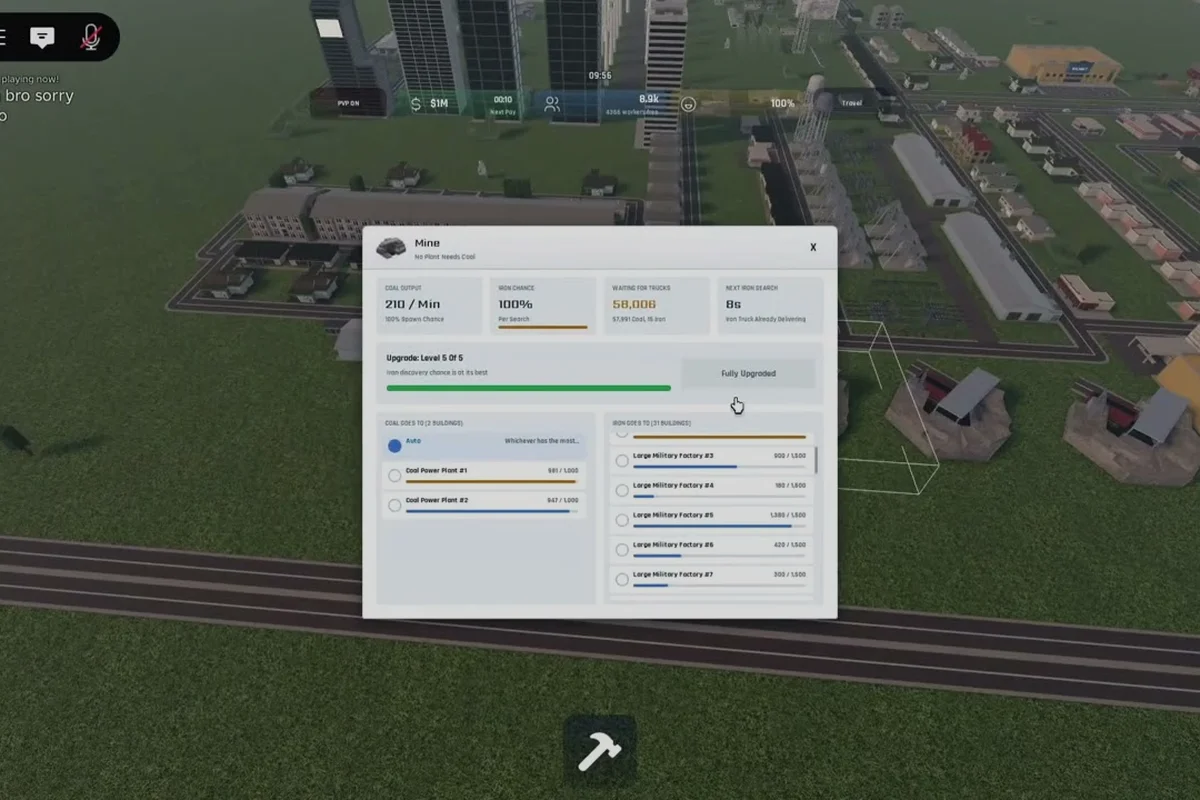
Every city in Build and Conquer stands on a tight chain of inputs, and the moment one link cracks, the whole economy stutters. Iron ore feeds the smelters that output Steel Ingots, fuel drives the vehicles that move those ingots, and electricity keeps the assembly line alive. This resource guide walks through the V0.1 beta loop from the first ore you mine to the grid upgrades that keep your power shortage from cascading into a blacked-out base.
Players who want a deeper drill on the iron pipeline can pair this overview with our iron farming walkthrough. Before you read further, remember that the V0.1 beta rebalanced steel acquisition in a recent hotfix, so treat every number below as a working baseline rather than gospel.
According to community gameplay footage, raw materials in Build and Conquer are gathered from resource nodes scattered across the map and form the backbone of your base-building economy, as demonstrated in various Build and Conquer gameplay videos.
Core Raw Materials and What They Unlock
The Build and Conquer resource tree branches into four families: ore-based metals, refined metals, energy carriers, and utilities. Each family has its own bottleneck, and missing one starves every downstream building. The table below shows the current V0.1 relationship between raw inputs and the structures that depend on them.
| Raw Material | Refined Output | Primary Consumers | Typical Bottleneck |
|---|---|---|---|
| Iron Ore | Steel Ingots | Tank factories, construction yards, rail depots | Smelter throughput |
| Copper Ore | Copper Wire | Power plants, communication towers | Limited mine density |
| Crude Oil | Fuel | Vehicles, aircraft, generators | Refinery capacity |
| Coal | Electricity | Coal-fired plants, steel mills | Mine depletion rate |
| Water | (utility) | Residential zones, farms, cooling towers | Network coverage gaps |
Iron and steel sit at the base of almost every production line you build. According to community testing on the V0.1 beta branch, players who skip an early Iron Mine end up borrowing time from their fuel reserves because trucks stall without steel chassis. Copper is rarer on the map, so most commanders guard the few nodes they find behind a defensive perimeter. Crude Oil and coal power the same grid in different ratios, which is why the choice between them is usually a logistics question rather than a power question.
The water utility is the silent killer in V0.1. Residential zones lose happiness and population growth when they sit outside a connected water network, and that loss shows up as a tax-revenue drop before you see it in any material counter. The full network plumbing is covered separately, but the short version is that every new housing block should be planned around an existing pipe main.
How Materials Interact in V0.1
The beta introduced a soft dependency: every Steel Ingot consumed by a factory also pulls a small amount of electricity, even if the plant sits on a fueled backup. This change means a "fueled" base is not actually off-grid. Players who treat fuel and electricity as separate problems tend to discover the dependency the hard way when a fully fueled tank factory refuses to spawn vehicles. Plan the grid before you build the steel mills, not after.
Tracking Iron and Steel in V0.1
Iron is the most forgiving raw material in the early game because the nodes are common and the smelter chain is short. Steel is where things get tricky. The smelter recipe changed in the October 2026 hotfix, so older screenshots showing a 1-to-1 iron-to-steel ratio are no longer accurate. The current chain requires iron plus a small coal input, which means a stalled coal mine can also stall your steel output even when iron is plentiful.
| Stage | Input | Output | Approximate Cycle | Storage Cap |
|---|---|---|---|---|
| Iron Mine | (none) | Iron Ore | Short | High |
| Smelter | Iron Ore + Coal | Steel Ingots | Medium | Medium |
| Tank Factory | Steel Ingots + Fuel | Tank | Long | Low |
| Construction Yard | Steel Ingots + Wood | Building | Medium | Low |
The Iron Mine itself is cheap to place, but its output is capped by the surrounding terrain. Flat tiles with a visible ore seam are the best spots, while rocky or forested tiles barely register. Once a mine is up, the next step is a Smelter placed within road range, because the ore must be trucked to the smelter before the next tick.
The full sourcing checklist is in our industrial resources breakdown, but the practical takeaway is that steel production needs three things running in parallel: ore, coal, and a working road. Lose any one and the line idles.
Common Iron Mistakes
New commanders often place mines first and smelters later, which leaves ore sitting in storage until the smelter comes online. Because storage caps are limited, the surplus ore can be lost to overflow. Build the smelter within the same construction batch as the mine whenever possible. Another common slip is letting trucks idle on long detours; a single one-tile road shortcut can shave seconds off every delivery and double the effective output of a small fleet.
Diagnosing the Fuel Shortage Fix
Fuel shortages are loud. Vehicles stall mid-route, generators shut down, and your base economy starts bleeding production in waves. The root cause is almost always one of three things: not enough crude oil coming in, a refinery bottleneck, or a storage tank that is too small for the demand spike.
| Symptom | Likely Cause | Quick Check |
|---|---|---|
| Refinery output is zero | No Crude Oil in storage | Hover the refinery, check input bar |
| Tanks stop rolling mid-map | Fuel tank drained | Check vehicle storage cap |
| Generators throttle | Backup fuel reserve empty | Open power tab, see reserve bar |
| Idle refineries but empty tanks | Storage cap hit | Build a second tank, link by road |
The fastest fuel shortage fix in V0.1 is to drop a second Fuel Tank next to the existing one and connect it with a one-tile road segment. Storage caps are generous, and the extra capacity often outlasts the spike. If the tank is already full, the next move is the refinery: a single extra Refinery placed near a crude oil node can triple fuel output without changing anything else.
A subtler issue is vehicle routing. Trucks in V0.1 take the shortest paved road, but they will avoid a tile if a construction site blocks the lane. Build fueling depots on flat ground away from active construction, and the fuel network will stay clean. For a deeper look at the full chain, the fuel production guide walks through refinery ratios and optimal node placement.
When Fuel Is Not the Real Problem
Sometimes the "fuel shortage" warning actually points to a power shortage masquerading as fuel drain. Backup generators consume fuel only when the grid is overloaded, so a base that blacks out at peak hour burns through tanks twice as fast. Stabilize the grid first, and the fuel warning often disappears on its own.
Stabilizing the Power Shortage Fix
Power is the most volatile raw material because demand spikes the moment a new factory comes online. A base that runs cleanly at 80% load can collapse to 40% the instant a tank factory spins up, and the only way to keep that from cascading is to plan headroom into the grid from the start.
| Power Source | Output Profile | Fuel Required | Best Use Case |
|---|---|---|---|
| Coal Plant | Steady, high | Coal | Baseline grid |
| Fuel Generator | Medium, fast to build | Fuel | Bridge power |
| Nuclear Plant | Very high, slow to build | (none, but water-cooled) | Endgame grid |
| Solar Array | Low, weather-dependent | (none) | Niche supplement |
The cleanest power shortage fix is to oversize the first coal plant. A single mid-tier plant covers an early base comfortably, but two small plants on separate grid segments protect you from a single point of failure. V0.1 added a soft "brownout" mechanic that throttles buildings when the grid sags, so a brownout warning bar is the earliest signal that you need a second plant.
Fuel generators are the emergency button, not the foundation. They burn through reserves in hours and force a fuel-vs-power trade that is hard to win. Use them to bridge the gap while a permanent plant is constructed, then decommission them once the new plant is online. The full grid-balancing math lives in our power balance guide, which covers transformer placement and demand forecasting.
The Nuclear Question
Nuclear plants are tempting because they output more power than three coal plants and require no fuel. The catch is the water dependency: a nuclear plant without a connected Water Pipe will refuse to operate and will sit as a white elephant on the map. Plan the water network before the plant placement, or the build slot is wasted. For early-game commanders, coal remains the safer choice until the water grid is established.
Closing the Water Shortage Fix Loop
Water is the most underestimated resource in V0.1 because it does not appear in any production counter. Instead, it shows up as a happiness tax on residential zones and a hard "no power" flag on nuclear and advanced agricultural buildings. A water shortage fix starts with checking the network coverage overlay, not the resource counter.
| Building | Water Need | Symptom When Missing |
|---|---|---|
| Residential Zone | High | Population loss, tax drop |
| Farm | Medium | Yield halved |
| Nuclear Plant | Very high | Plant disabled |
| Cooling Tower | Medium | Adjacent factory overheats |
The simplest water shortage fix is a Water Tower placed uphill from the consumer block, connected by a single pipe main. Towers have generous range, so one tower can cover an entire early-game district. The trap is putting the tower too close to a road junction, because pipe segments break when the road is upgraded, and a broken pipe silently drops the whole downstream network.
Pipes do not need power to operate, but they do need to be contiguous. A single missing tile disconnects every building beyond it, which is why visual inspection of the pipe network is faster than reading any UI counter. Our water network connection guide covers the precise pipe rules and the common road-upgrade pitfalls.
Water as a Strategic Resource
Once the network is stable, water becomes a force multiplier. Farms near a pipe main produce more food per worker, which means more population, which means more tax revenue to fund the next expansion. Treat water as a planning layer drawn on top of the city rather than a utility you wire last, and the rest of the resource tree tends to fall into place on its own.
Putting It All Together
The four raw material families in Build and Conquer are not independent. Iron and steel require coal and a working grid. Fuel requires crude oil and refineries that themselves need power. Water enables the population that funds everything else. The cleanest economy treats all four as a single planning surface, not four separate tabs.
A practical ordering for a new commander in V0.1: secure an iron node and a coal node on the same map edge, build a smelter and a small coal plant in the same batch, lay a water tower above the first residential block, and only then start a fuel depot. That sequence avoids the most common cascading failure, which is a fueled base with no steel chassis because the smelter was waiting on a coal delivery that the grid could not support.
| Priority | First Build | Reason |
|---|---|---|
| 1 | Iron Mine + Coal Mine + Smelter | Steel is the chokepoint |
| 2 | Coal Plant + Power Line | Grid headroom before expansion |
| 3 | Water Tower + Pipe Main | Population stability |
| 4 | Fuel Depot + Refinery | Vehicle and backup power |
| 5 | Tank Factory | Steel and fuel must both be stable |
Each step feeds the next, and skipping ahead tends to surface as a shortage warning rather than a clean failure. Watch the warning bars, build the next bottleneck before the current one peaks, and the V0.1 beta economy becomes much more forgiving than its reputation suggests.
Frequently Asked Questions
Where do I get iron in Build and Conquer during the V0.1 beta?
Iron is mined from Iron Ore nodes that appear as dark rocky deposits on the map. Place an Iron Mine directly on the node for full output, then connect it by road to a Smelter to convert the ore into Steel Ingots. Nodes on flat terrain yield more than nodes on rocky or forested tiles.
How do I fix a fuel shortage when refineries are running?
If the refineries are producing but your vehicles still stall, the issue is almost always storage or routing. Add a second Fuel Tank connected by road, since the default tank cap is the most common hidden limit. If storage is healthy, check that trucks are not being blocked by active construction sites on their delivery path.
What is the fastest power shortage fix before I can build a nuclear plant?
A second Coal Plant on a separate grid segment is the most reliable early power shortage fix. It requires coal from an existing mine, adds steady output, and protects the base from a single-plant failure. Avoid relying on Fuel Generators for more than a few hours, because they burn reserves faster than most new players expect.
Why does my nuclear plant refuse to turn on?
The plant needs a connected Water Pipe network before it will accept any grid load. Place a Water Tower within pipe range, draw a contiguous pipe main to the plant, and the building will activate on the next tick. If the pipe has any gap, the plant stays disabled no matter how strong the rest of the grid is.
Does the V0.1 beta rebalance affect my older steel builds?
Yes. The October 2026 hotfix changed the smelter recipe so that Steel Ingots now require a small coal input in addition to iron ore. Older bases that relied on a pure iron-to-steel chain will see steel output drop until coal is routed to the smelter, so recheck the recipe against the current build before you trust any stored surplus numbers.