
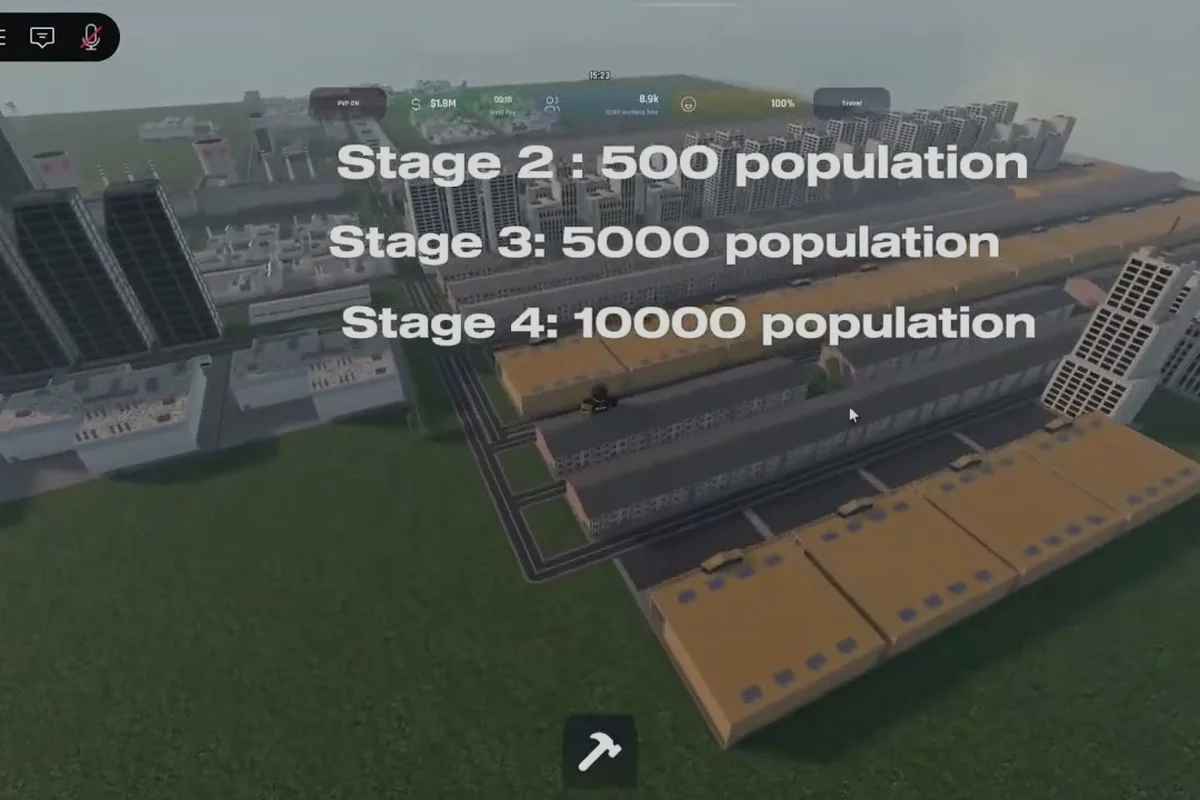
Planning your Build and Conquer how long to reach level 5 timeline matters because city tiers gate every meaningful unlock in the V0.1 beta. The jump from a founding settlement to an endgame metropolis requires hitting specific population thresholds, and each tier reshapes what your city can produce. This walkthrough breaks down the verified level 1 to 5 path, flags which numbers are community-compiled versus creator-confirmed, and gives you a realistic upgrade schedule. Once you’ve locked in those early milestones, use the Build And Conquer City Progression breakdown to see how later tiers, unlockable districts, and production chains extend that same verified-vs-community data into the mid and late game.
What City Level Does in Build and Conquer
City level in Build and Conquer functions as the core progression spine that determines which buildings, units, and production chains you can access. When you upgrade your city, you are not just getting a cosmetic title change — you are unlocking entirely new gameplay layers that shift how you approach expansion, defense, and resource management. Understanding what city level does before you start grinding population is essential because it dictates your build order and prevents wasted construction time.
The official Roblox page for Build and Conquer lists the game as a strategy title supporting up to 8 players per server, which means city level progression also affects how you compete or cooperate with other players on the map. A higher city tier gives you access to military production that lower-tier settlements simply cannot field, and that gap becomes decisive in any contested territory scenario.
| City Level | Tier Name | Key Unlocks | Population Threshold |
|---|---|---|---|
| Level 1 | Founding Stage | Housing, farms, basic services | 0 (starting tier) |
| Level 2 | Early Military | Guns, soldiers, early military production | 250 population |
| Level 3 | Mid-Game Tier | Expanded building options, stronger units | Community-compiled, unconfirmed |
| Level 4 | Advanced City | Heavy industry, vehicle production | Community-compiled, unconfirmed |
| Level 5 | Endgame Tier | Highest known tier, featured in endgame content | Community-compiled, unconfirmed |
The table above highlights a critical data gap that every player should understand before planning their Build and Conquer how long to reach level 5 timeline. Only the level 2 threshold of 250 population is creator-verified as of the October 2026 beta state. Levels 3 through 5 have thresholds that are community-compiled and remain unconfirmed, which means your actual time to reach those tiers may vary depending on balance patches and beta updates.
How City Level Perks Compound
City level perks in Build and Conquer do not simply add new buildings — they multiply your economic output because each tier unlocks production chains that feed into the next tier's requirements. The Founding Stage keeps you limited to housing, farms, and basic services, which means your population growth is capped by food production and residential capacity. Reaching the Early Military tier at 250 population changes the equation because you can now produce guns and soldiers, giving you the ability to defend expansion zones or contest resource nodes that would otherwise be off-limits.
The jump from level 2 to level 3 represents the transition from a defensive settlement to an offensive-capable city. Community reports from the V0.1 beta indicate that level 3 unlocks expanded building options and stronger units, while level 4 introduces heavy industry and vehicle production. These perks are not just incremental stat boosts — they fundamentally change what your city can do on the map, which is why knowing when to upgrade your city matters more than raw population count alone.
Build and Conquer Level 1 to 5 Walkthrough: The Verified Path
The Build and Conquer level 1 to 5 walkthrough starts with understanding that level 1 is your founding stage and requires no population threshold to reach. You begin the game with access to housing, farms, and basic services, which means your first priority is establishing a stable food supply and residential capacity. The early game is about building the foundation that will carry you through the population thresholds ahead.
Your first major milestone is reaching 250 population to unlock level 2, which is the only creator-verified threshold in the current beta. This means you need to focus on expanding housing capacity and food production simultaneously, because population growth stalls if either resource falls behind. Players who rush housing without scaling farms will hit a food bottleneck, while players who overinvest in farms without residential space will see their population plateau.
| Walkthrough Stage | Primary Focus | Key Actions | Expected Outcome |
|---|---|---|---|
| Level 1 to 2 | Population growth | Build housing, expand farms, maintain basic services | Reach 250 population, unlock military production |
| Level 2 to 3 | Military expansion | Produce guns and soldiers, secure resource nodes | Unlock expanded buildings and stronger units |
| Level 3 to 4 | Industrial scaling | Build heavy industry, prepare for vehicle production | Unlock advanced city tier |
| Level 4 to 5 | Endgame optimization | Maximize all production chains, defend territory | Reach highest known tier |
The walkthrough above assumes you are playing efficiently and not losing population to raids or resource shortages. Because the V0.1 beta changed often in October 2026, community footage of how long to reach level 5 covers only the current beta state, and any specific hour count you see from older content may be outdated. Treat the level 2 threshold as your anchor point and build your timeline around reaching that milestone first.
When to Upgrade Your City
Knowing when to upgrade your city in Build and Conquer is a timing decision that separates efficient players from those who stall out. The temptation is to upgrade as soon as you hit the population threshold, but upgrading too early can leave you without the resource buffer needed to sustain your new tier's production demands. A better approach is to hit the threshold, then build a surplus of food and basic materials before committing to the upgrade.
The 250 population unlock is particularly important because it gates your first military production, which means upgrading to level 2 without a plan for using those soldiers wastes the perk. If you are on a server with aggressive neighbors, upgrading early gives you defensive capability that might save your settlement. If you are playing on a peaceful server, you might delay the upgrade slightly to build more economic infrastructure first. The decision depends on your server context, but the general rule is to upgrade when you have a clear use for the new unlocks.
Population Thresholds and Growth Strategy
Population thresholds in Build and Conquer are the primary gate for city progression, and understanding how to grow population efficiently is the single most important skill for reaching level 5. The verified 250 population requirement for level 2 gives you a concrete target, but the community-compiled thresholds for levels 3 through 5 mean you should plan for escalating requirements that likely increase significantly with each tier.
Population growth depends on three factors: housing capacity, food production, and basic services. If any of these three falls behind, your population growth stalls regardless of how much you invest in the other two. The most common mistake new players make is treating housing as the only population driver, then wondering why their city stops growing when food runs out. A balanced approach that scales all three factors simultaneously is the fastest path through the early tiers.
| Growth Factor | Role in Population | Common Bottleneck | Optimization Tip |
|---|---|---|---|
| Housing Capacity | Sets maximum population ceiling | Not enough residential buildings | Build housing ahead of food demand |
| Food Production | Sustains current population | Farm output below consumption | Expand farms before adding housing |
| Basic Services | Maintains population stability | Service buildings too far from homes | Place services centrally |
The table above shows why population growth is a systems problem rather than a single-building problem. When you hit a growth plateau, the bottleneck is almost always in one of these three factors, and diagnosing which one is falling behind saves you hours of wasted construction. Players who track their food surplus and housing vacancy rates can predict growth stalls before they happen.
The Build and Conquer Unlock Progression Chart
The Build and Conquer unlock progression chart maps out what each city level gives you access to, and it is the reference tool you should keep in mind while planning your build order. Level 1 gives you the founding essentials, level 2 adds military production at the verified 250 population mark, and levels 3 through 5 expand your options in ways that community reports describe as building options, stronger units, heavy industry, and vehicle production.
What makes this progression chart valuable is that it shows you the opportunity cost of staying at a lower tier. Every hour you spend at level 1 is an hour without access to guns and soldiers, which means you are vulnerable to players who hit level 2 faster. The chart also reveals that the biggest gameplay shift happens at level 2, because military production fundamentally changes how you interact with the map and other players.
Practical Timeline for Reaching Level 5
Estimating your Build and Conquer how long to reach level 5 timeline requires separating verified data from community estimates. The only hard number you can anchor to is the 250 population requirement for level 2, which is creator-confirmed. Everything beyond that point is based on community-compiled thresholds that remain unconfirmed in the V0.1 beta, so your actual time to level 5 will depend on how efficiently you play and whether the developer adjusts thresholds in future patches.
A realistic approach is to break your timeline into segments: the level 1 to 2 segment has a known endpoint, while the level 2 to 5 segments are estimates that you should treat as flexible. Players who focus on population growth and avoid military conflicts can move through the early tiers faster than players who get drawn into fights, because military production consumes resources that could otherwise go toward housing and farms.
| Timeline Segment | Estimated Duration | Key Variables | Confidence Level |
|---|---|---|---|
| Level 1 to 2 | Fastest segment, known endpoint | Food production, housing capacity | High (250 population verified) |
| Level 2 to 3 | Moderate, varies by server | Military conflicts, resource competition | Medium (community-compiled) |
| Level 3 to 4 | Longer, requires industrial scaling | Heavy industry build time, resource stockpiles | Low (community-compiled) |
| Level 4 to 5 | Longest, endgame optimization | All production chains, territory defense | Low (community-compiled) |
The confidence levels in this table reflect the reality of the V0.1 beta state as of October 2026. Because the beta changed often during this period, any specific hour count for the later tiers should be treated as a rough estimate rather than a guaranteed target. The most reliable strategy is to focus on reaching level 2 as efficiently as possible, then adapt your timeline based on what you observe in your own game.
Optimizing Your Level 1 to 2 Speed
The fastest way through the early game is to prioritize food production before housing, because a food surplus lets you sustain a larger population without stalling. Build farms first, then add housing as your food output increases, and place basic services centrally so they cover the maximum number of homes. This order prevents the growth plateau that happens when you build housing first and then scramble to catch up on food.
Players who follow this build order typically reach the 250 population threshold faster than those who rush residential buildings, because they never hit a food bottleneck that forces them to pause population growth. The key insight is that population growth is a rate-limited process, and the limiting factor is almost always food production in the early game. Once you have a stable food surplus, housing becomes the constraint, and you can scale both in tandem.
City Level Perks and Long-Term Planning
City level perks in Build and Conquer are the rewards that justify your population grind, and understanding what each tier gives you helps you plan your long-term strategy. The Founding Stage perks are basic but essential, giving you the housing, farms, and services that form your city's core. The Early Military perks at level 2 are transformative, because guns and soldiers change your city from a passive settlement into an active participant in map control.
The later tiers build on this foundation with expanded building options, stronger units, heavy industry, and vehicle production. These perks are not just incremental improvements — they unlock entirely new strategies that are unavailable at lower tiers. A level 4 city with vehicle production can project power across the map in ways that a level 2 city simply cannot match, which is why the grind to higher tiers remains worthwhile despite the unconfirmed thresholds.
| City Level | Perk Category | Strategic Impact | Priority for Most Players |
|---|---|---|---|
| Level 1 | Basic infrastructure | Establish stable settlement | Essential, cannot skip |
| Level 2 | Military production | Defend territory, contest resources | High, first major power spike |
| Level 3 | Expanded buildings, stronger units | Offensive capability | Medium, depends on server context |
| Level 4 | Heavy industry, vehicles | Map-wide power projection | Medium, requires industrial base |
| Level 5 | Endgame tier | Maximum production and military power | Low, long-term goal |
The priority column reflects a practical assessment of where most players should focus their energy. Level 2 is the highest priority because it is the first verified threshold and the first major power spike, while levels 4 and 5 are long-term goals that require significant investment. If you are playing on a competitive server, the military perks at level 2 become even more important, because falling behind on military production leaves you vulnerable to raids.
Balancing Military and Economic Growth
The tension between military and economic growth defines the mid-game in Build and Conquer, and how you balance these two priorities determines your progression speed. Military production consumes resources that could go toward housing and farms, but it also protects your city from raids that would destroy your economic base. The optimal balance depends on your server context: peaceful servers reward economic focus, while contested servers punish players who neglect military.
The level 1 to 5 walkthrough in this guide assumes you are making smart trade-offs between these two priorities at each tier. Reaching level 2 unlocks military production, but that does not mean you should immediately pivot to full military output. Instead, produce enough soldiers to defend your territory while continuing to grow your population toward the next threshold. This balanced approach keeps your progression moving without leaving you exposed.
Frequently Asked Questions
How long does it take to reach level 5 in Build and Conquer?
There is no verified hour count for reaching level 5 in the V0.1 beta. The only confirmed threshold is 250 population for level 2, while levels 3 through 5 are community-compiled and unconfirmed. Your actual time depends on play efficiency, server competition, and any balance patches the developer releases.
What is the population threshold for level 2?
Level 2 requires exactly 250 population, which is the only creator-verified threshold in the current beta. This unlock gives you access to guns, soldiers, and early military production. Focus on scaling food production and housing capacity simultaneously to reach this milestone as quickly as possible.
What does city level do in Build and Conquer?
City level gates building unlocks, unit production, and strategic capabilities. Level 1 provides housing, farms, and basic services. Level 2 adds military production. Levels 3 through 5 expand building options, add stronger units, and eventually unlock heavy industry and vehicle production, according to community reports.
When should I upgrade my city?
Upgrade when you have a clear use for the new tier's unlocks and a resource buffer to sustain increased production demands. For level 2, upgrade when you hit 250 population and have a plan for military production. Upgrading too early without resource surplus can stall your progression.
Are level 3 to 5 population thresholds confirmed?
No, levels 3 through 5 thresholds are community-compiled and remain unconfirmed as of October 2026. The beta changed often during this period, so treat any numbers you see for these tiers as estimates. Cross-check numeric claims against the verified 250 population anchor for level 2 before relying on them.
Reaching level 5 in Build and Conquer is a long-term goal that requires efficient population growth, smart upgrade timing, and a clear understanding of what each city tier unlocks. The verified 250 population threshold for level 2 is your first major milestone, and everything beyond that point depends on community-compiled data that may shift with beta updates. Focus on balancing food, housing, and services through the early game, then adapt your strategy based on the military and industrial perks that each subsequent tier provides.